Little Scroll
Book of RevelationThe Little Scroll is an open book in the hand of a mighty angel, and its importance lies in what happens when John the Apostle takes and eats it: receiving the message becomes an enacted experience, followed by a renewed command to prophesy. The account does not disclose the scroll’s contents. Instead, it emphasizes its transfer to John, the contrast between sweetness and bitterness, and the commission that follows. In the book’s interpretation, this encounter is also an interruption in the writing of Revelation, helping explain how an episode can appear in the text according to when it was revealed rather than when its events occur.
Appearance and Presentation
The scroll appears in a vision in Revelation 10. A mighty angel descends from heaven, clothed with a cloud, with a rainbow above his head, a face like the sun, and feet like pillars of fire. He holds the Little Scroll open. His stance spans sea and land: one foot is set on the sea and the other on the earth. The scene gives the small book a place within a large, cosmic tableau, while keeping the object itself distinct and graspable in the angel’s hand.
The angel cries out with a voice compared to a lion’s roar, and seven thunders answer. The narrative then shifts from this vast display to a direct instruction from a voice John hears from heaven: he is to go and take the open scroll from the angel. That sequence matters. The scroll is not simply shown as a distant symbol; it becomes the focus of an instruction that draws John into the vision and makes him responsible for what follows.
Taking and Eating the Scroll
John approaches the angel and asks for the book. The angel tells him to take it and eat it, foretelling that it will taste sweet in his mouth but become bitter in his stomach. John carries out the instruction, and the two-part experience occurs as predicted. The account offers no explanation of the scroll’s written contents or of the precise cause of the bitterness. Its emphasis is on the contrast itself and on John’s obedience to the command.
Eating makes the reception of revelation physical within the vision: John does not merely look at, read, or carry the scroll but takes it into himself. Its sweetness and bitterness mark that reception as mixed rather than uncomplicated. The text does not specify what those qualities mean, so they should not be assigned a single definite interpretation on the evidence given. What is explicit is the order of events: the angel announces the contrast, John eats, the taste is first sweet and then bitter, and a further instruction follows. The object’s role is therefore inseparable from the action performed with it.
The Commission That Follows
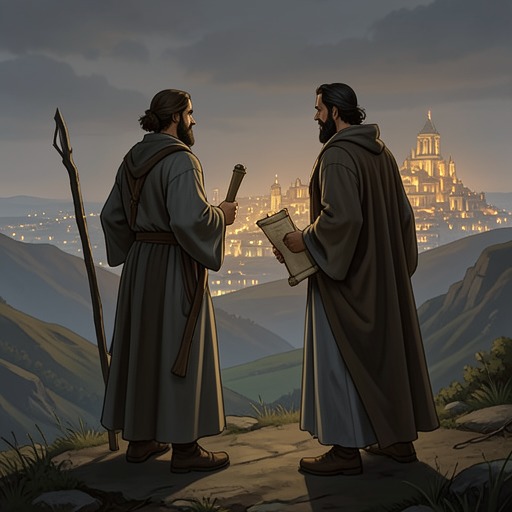
After John has eaten the Little Scroll, the angel tells him that he must prophesy again before many peoples, nations, languages, and kings. The commission expands the scene beyond the private exchange between John and the angel. The book has been received by one person, but the task attached to it addresses a broad range of peoples and rulers. In this way, the scroll functions in the episode as the immediate prelude to renewed prophetic work, not as an object whose significance ends when it is consumed.
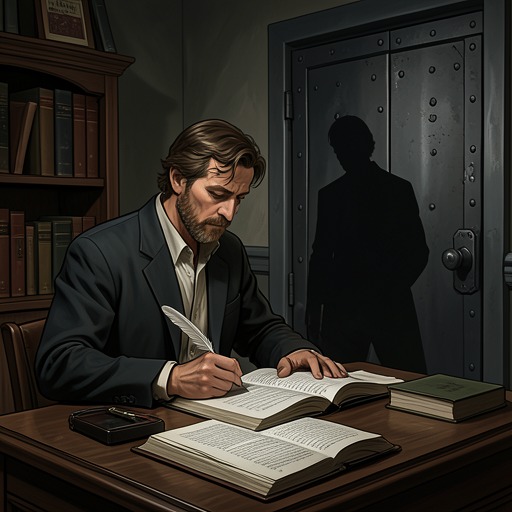
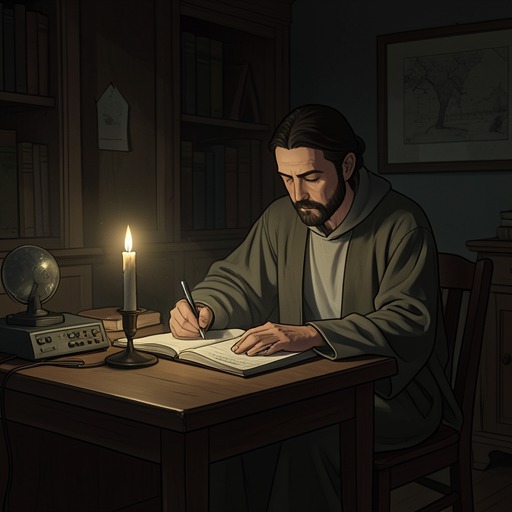
The book’s author connects that command with John’s responsibility to record the revelation. In an imagined reconstruction, John returns to his circumstances on Patmos with the vision to write down, and friends smuggle writing materials to him and later carry his writings out. The author pictures John already working through what is now chapter 10 when the angel appears with additional revelation. This is presented as the author’s account of how the writing may have proceeded, not as a further detail supplied by the vision itself. Within that reconstruction, the Little Scroll marks an addition to John’s assignment and leads directly to the instruction that he prophesy again.
Place in the Book’s Structure
The book uses the Little Scroll episode to illustrate its larger argument that Revelation is not wholly chronological. The author imagines John writing in the order in which revelations were given, rather than arranging every passage by the time of the events described. On this reading, the angel’s appearance interrupts John’s ongoing work; John incorporates the additional revelation and then continues where he had left off. The episode thus becomes both a vision about prophetic commission and an example in the author’s explanation of Revelation’s composition.
The author further describes angelic revelations as supplementary material, comparable to footnotes that illuminate what will happen in the last days. That framing is the author’s interpretive model, not an identification of the scroll’s undisclosed contents. It nevertheless clarifies why the Little Scroll matters beyond its brief appearance: its transfer and consumption connect an angelic interruption to John’s renewed task, while the interruption supports the book’s distinction between the order of revelation and the chronology of future events.